54 years ago today, Simon and Garfunkel have the #1 single in the US with “Bridge Over Troubled Water.” The composition was spurred by the line “I’ll be your bridge over deep water if you trust in my name,” as sung by Claude Jeter on the Swan Silvertones recording of “Mary Don’t You Weep.” Paul personally handed a check to Jeter years later as thanks for the inspiration. Parts of the melody were adapted by Simon from Bach’s “O Sacred Head, Now Wounded.” Art Garfunkel didn’t want to sing the song initially. He liked Simon’s falsetto take on the demo and urged Paul to take the lead. Simon thought it was better for Art to do it but agreed to add a harmony part toward the end. Garfunkel and co-producer Roy Halee suggested there be an additional verse, which Simon provided but didn’t much care for. The “sail on silvergirl” line referenced Paul’s then-wife Peggy’s first gray hairs. The backing track featured members of The Wrecking Crew: Hal Blaine on drums, Joe Osborn on bass (two different bass parts actually), and Larry Knechtel on keyboards. The string arrangement was by Jimmie Haskell, who also transposed Simon’s original guitar part to piano to better suit Garfunkel’s voice. I wouldn’t have known any of this in 1970, but I do clearly remember hearing the song at the time and being struck by the boom of the drums, which had been recorded in an echo chamber to achieve the effect.
I also know that on March 13, 1970, my Dad picked me up from school in the Bronx. To the best of my memory, which isn’t much at this point, this was the only time that happened. He wanted to show me something, which ended up being my new room in a house in Yonkers, NY, which my parents had quietly bought and moved in to on this very day in 1970. “Bridge Over Troubled Water” seems just about right to be the #1 song at the time, but let’s leave it at that.
Yonkers, like other cities, has its good and bad parts. We lived in a decent section, just up the hill from the Bronx River Parkway. The main drag in Yonkers is Central Avenue. It is essentially one miles-long strip mall, from the Cross County Shopping Center off the New York Thruway, just above Yonkers Raceway, all the way up to White Plains, which was a pit in ’70 but is now apparently the place to be. But back to the house. My first room, upstairs, had been a small den. The house was perched on the side of a cliff, and it felt like it looking out the windows. There was no door on the room. I was still too young for it to have mattered in certain ways, but that quickly changed when I realized I could hear the constant, heated “chats” from my parents’ adjacent room. I also couldn’t sneak in the 9″ black and white TV. I eventually moved downstairs to another room. There was a door. It was basically the Beach Boys song “In My Room,” which was fine by me. I was going to play records anyway. I was inspired to decorate from a cousin of mine who had a room at her home in Connecticut that was a poster collage, walls and ceiling. FYI, I didn’t have the Farrah Fawcett poster. Cheryl Ladd was my Angel.
One thing about the house was the hum of the electric moving chair on a track on half of the stairs. I always knew when my Mother was soon to be in the vicinity of the downstairs. It had been installed for her right after the move-in. She had contracted polio in the early 50’s before there was a vaccine, and one of her legs was in a brace for the rest of her life into the early 90’s. I’m sure the initial years were a nightmare, and the ensuing years not a great deal better. But she managed out of necessity, made it to errands and made it to a boatload of Mah Jongg and Bridge games. Mainly, she didn’t sit around. A couple of years before she earned her rainbow, we lost a tremendous artist I’ve always identified with. And I’ve identified with him because of my Mother.
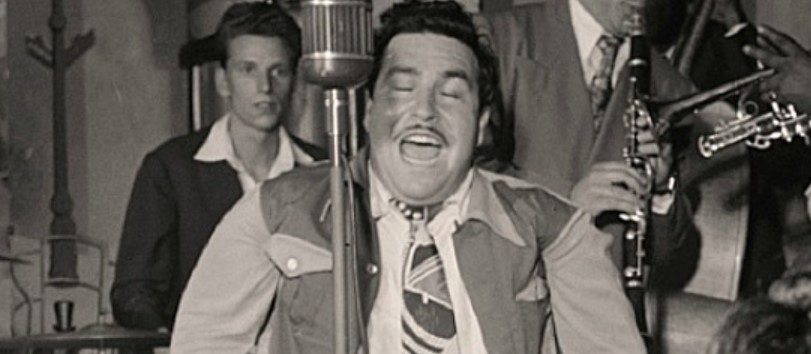
On this day in 1991, we lost the songwriting giant Doc Pomus, born Jerome Felder in June 1925, in Brooklyn. Mike Stoller called him “the arch angel of rhythm and blues.” Doc too had contracted polio, at a much earlier age than my Mother. His polio was further exacerbated by an accident, which had him living on crutches from childhood on, until he was wheelchair-bound. He’d tried to make it as a performer at first, cutting sides for several labels including Chess Records. He particularly identified with African Americans, performing in clubs where he was often the only white person. He was well-respected by his club audiences, not only for his talent, but for performing with the use of crutches, not being held back by illness. He said “I didn’t want to be the crippled songwriter or the crippled singer. I wanted to be the singer or songwriter who was crippled. I wanted to be larger than life and a man among men.” He achieved it.
Big Joe Turner was Pomus’s lifelong idol. Doc wrote songs recorded by Big Joe himself, La Vern Baker, Ray Charles, and Ruth Brown. Eventually, Elvis Presley, Dion and the Belmonts, The Beach Boys, B.B. King, and The Drifters would be among the hundreds to record his work. Robert Plant and Rockpile tried out Doc’s “Little Sister,” recorded originally by Elvis:
Willy DeVille co-wrote several songs with Doc in the late 70’s, including “Something Beautiful Dying” and the great “Just to Walk That Little Girl Home”:
John Lennon and Bob Dylan loved Pomus. In the mid-80’s, during a bout of writers block, Dylan sought out Doc for advice that meant so much to him that he recorded a version of Big Joe Turner’s 1956 Doc-penned hit “Boogie Woogie Country Girl” for the Pomus tribute album Till The Night Comes:
To my mind, Doc’s greatest song is his most heartbreaking when you know the backstory, the sublime “Save The Last Dance For Me,” a #1 hit for The Drifters in 1960. Doc wrote the song on his own wedding day to Broadway actress and dancer Willi Burke. The wheelchair-bound Pomus was forced to watch her dance with guests at the reception, writing the song to remind her to save the last dance for him, that it would be in his arms she’d be when the party was over. The song has been recorded more than 300 times. Both Buck Owens and Emmylou Harris took versions to the Top 10 on the Country singles charts. Jerry Lee Lewis, Dolly Parton, Jay Black, The Troggs, Paul Anka, Michael Buble, and Bobby Vee are among those to give it a try.
On Today’s Playlist, you can find Ike & Tina’s version of “Save The Last Dance For Me,” along with 24 other Doc Pomus-penned tracks. Opening the playlist is Doc himself with one of his Chess recordings, “Send For The Doctor”:
Please share this post or any of our past blogs with anyone you think may be interested.


 SomethingIsHappening
Leave a reply to tentshowqueen Cancel reply