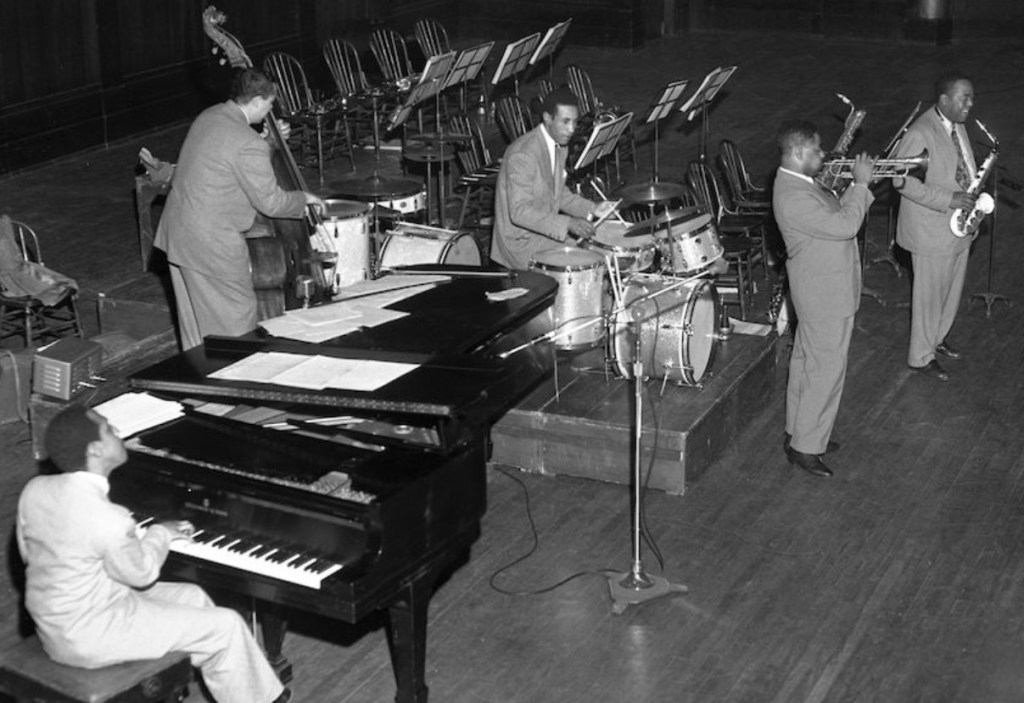
71 years ago today, The Quintet performs their one and only concert, often referred to as “The Greatest Jazz Concert Ever.” On May 15, 1953, Dizzy Gillespie, Charlie Parker, Charles Mingus, Bud Powell and Max Roach came together to perform at Toronto’s Massey Hall, presented by the Toronto New Jazz Society (TNJS). The original plan was for the five musicians and the TNJS to share the proceeds, but the booking was mismanaged from the start. The local promotion was lackluster at best. More importantly, the show was booked on the same night as a Heavyweight Championship match between Rocky Marciano and Jersey Joe Wolcott in Chicago, cutting into the chance of a full-house at Massey Hall. Potential spectators stayed home to listen to the match on the radio (Dizzy himself would step off stage periodically during the concert to check the fight on his transistor). The turnout was so poor the TNJS couldn’t pay the band their agreed upon fees, even issuing checks that would bounce (Charlie Parker received the only check that could be cashed). To make matters worse, the sound engineer showed up drunk, drawing the fury of Mingus, a situation understood to avoid at all costs. The recordings were subpar, especially with the poor audio quality of the bass and low tom-toms on the drums. Back in New York City with the recordings, Mingus and Roach re-played their parts along with the tapes, dubbing all to a new master recording.
The original release in late ’53 on Mingus’ own Debut Records label, The Quintet would be on two 10″ records, featuring the overdubbed recordings of all 6 of the full quintet performances. Charlie Parker was listed on the cover as Charles Chan for contractual reasons, referring to the fictional detective as well as Parker’s wife Chan. Seven other songs were performed as a trio lead by Bud Powell, with Mingus and Roach. Both sets would be released in various formats over the years, but in September of 2023, Concord Music released Hot House: The Complete Jazz At Massey Hall Recordings (Live At Massey Hall/1953). It includes the full program from that evening, along wih the original TNJS recording without the rhythm section overdubs. It’s a remarkable album:
Nine years later, on September 17, 1962, Mingus and Roach would come together again as the rhythm section behind Duke Ellington for what would become the album Money Jungle. Duke had approached United Artists producer Alan Douglas with the idea of a piano based trio recording. Douglas suggested Mingus. Mingus had worked with Duke years earlier, for exactly four days when he was fired for a fight with Ellington trombonist Juan Tizol (composer of “Caravan”). When Douglas contacted Mingus about the new album, Charles insisted on booking Max Roach to complete the rhythm section. The three met the day before the session. Max recalled that Ellington, unsigned at the time (Mingus was signed to United Artists), told them to think of him as “the poor man’s Bud Powell.” Roach also recalled that Duke told them he’d like to not only record his own compositions.
The trio chose to not rehearse. Roach arrived early at Sound Makers Studios for the 1p session, finding Duke was already there writing out material. The compositions were all his, despite what he’d told said the day before. Ellington handed out lead sheets with the basic melody line and harmony, along with a description for the mood of the piece. For one of the pieces, Duke wrote: “crawling around on the streets are serpents who have their heads up; these are agents and people who have exploited artists. Play that along with the music.” The group recorded on 3-track tape, with the album consisting of 7 tracks, 6 written by Ellington along with a version of “Caravan.” When Money Jungle was released in February ’63, it was on United Artists.
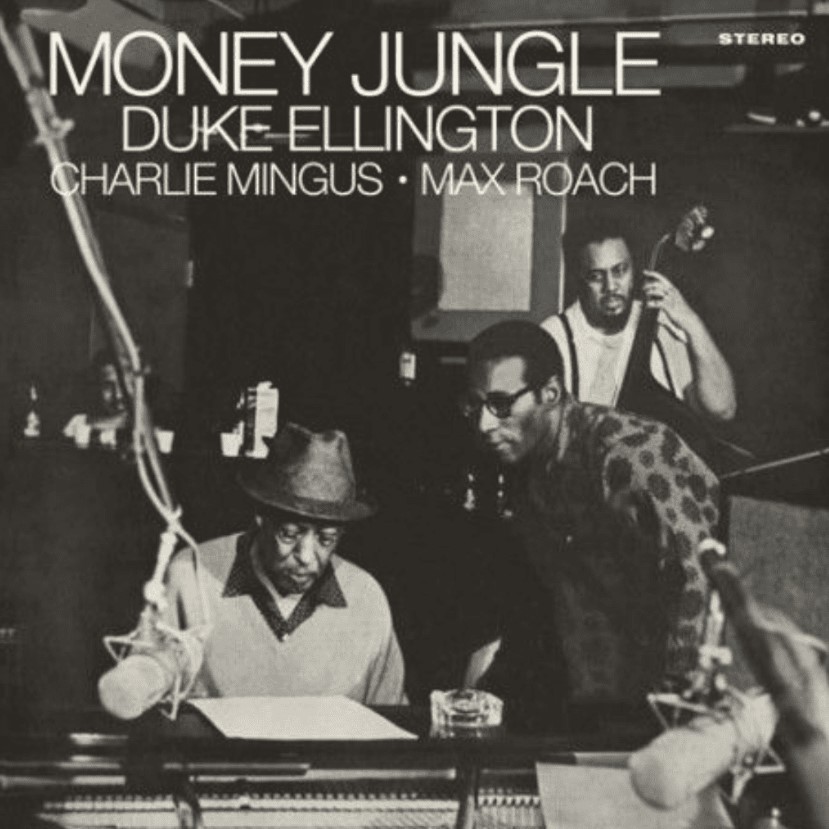
Stories have been told about difficulties during the session, most centering on tension with Mingus. The main story was him packing up and leaving the session part way through. Alan Douglas claimed Mingus was unhappy with Roach’s playing, and that Duke caught up with him down the street, persuading him to return. Duke’s version had him catching Mingus only as far as the elevator. Another story centered around Mingus being unhappy that none of his compositions were recorded, that only Duke’s were. Ellington’s son Mercer claimed the trio’s contract with United Artists was a two album deal, but no one could persuade Ellington, Mingus and Roach to ever work together again.
The recording is extraordinary, containing what may very well be Duke’s greatest piano playing. He’s out of the comfort zone of his own orchestra, forced to improvise with two iconoclasts 20+ years younger. Down Beat wrote in their review “Mingus and Roach, especially Mingus, push [Duke] so strongly that one can almost hear Ellington show them who’s boss – and he dominates both of them, which is no mean accomplishment.” Musicians have praised the album as well, from Fred Hersch to John Medeski. Elton John quoted Duke’s piano part in “Very Special” as the basis for one of his own rare instrumentals, “Out of the Blue,” from 1976’s Blue Moves:
Miles Davis, though, didn’t care for the recording. During a listening session for Down Beat, Miles criticized the line up, not as people or players, but as a trio. He said, “Max and Mingus can play together, by themselves. Mingus is a hell of a bass player, and Max is a hell of a drummer. But Duke can’t play with them, and they can’t play with Duke.” The album sounds alright to me. Hear it for yourself. Here’s a link, reissued with four alternate takes as well as two outtakes:
Please share this post or any of our past blogs with anyone you think may be interested.
#DukeEllington #Mingus #MaxRoach #MoneyJungle #TheQuintet #MasseyHall #DizzyGillespie #CharlieParker #BudPowell #Jazz
 SomethingIsHappening
Leave a comment