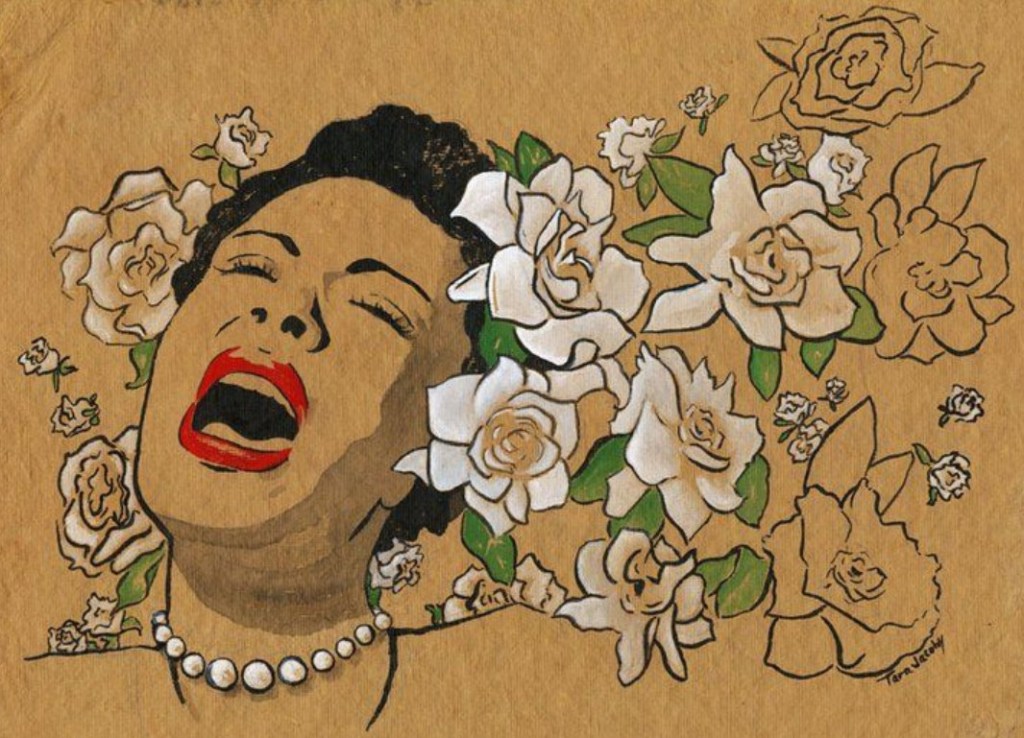
She was born Eleanora Fagan 109 years ago yesterday in Philadelphia, Pennsylvania. Her incredibly difficult upbringing is well documented, with a largely absent mother, spells in reform school, altogether dropping out of school at age 12, and working as an assistant in a brothel, all before turning 14. Her first love of music came from hearing Bessie Smith and Louis Armstrong records, especially loving Louis’ “West End Blues.” By her 15th birthday, Eleanora had moved with her mother to Harlem.
By her early teens, she was singing in Harlem jazz clubs. She took on a performing name from actress Billie Dove, and the man likely her father, Clarence Halliday, a jazz banjo player and guitarist. He had adopted the name Holiday for his own performances, and Eleanora used it as well. Billie Holiday would be discovered serendipitously by the legendary John Hammond in 1933. He went to Covan’s on West 132nd Street to see singer Monette Moore. Billie subbed for Moore that night and he was taken by her style and presence. He later said “her singing almost changed my music tastes and my musical life, because she was the first girl singer I’d come across who actually sang like an improvising jazz genius.”
Her career is the stuff of legend, with more albums and songs to outline than there is time at the moment. So I will focus on her penultimate album, the astounding Lady In Satin. Here is my well-worn original pressing, on Columbia “Nonbreakable” vinyl:

The album was recorded over three days, February 19-21, 1958, in Columbia’s 30th Street Studio. Billie had contacted producer Irving Townsend at Columbia Records following her refusal to renew her recording contract with Verve Records and producer Norman Granz. She’d recorded a dozen albums for Granz, most with various small jazz combos, often including musicians with whom she’d worked in the 30’s and 40’s, such as pianist Teddy Wilson. More importantly, Billie often re-recorded songs she’d done several times before. She had been in line to record albums of the Great American Songbook, but the deals fell through and those albums went to label mate Ella Fitzgerald. When she reached out to Townsend, she had the idea of something different than her Verve work. She wanted an orchestral album, complete with backing vocalists meant to sound like a choir. Townsend was as surprised as anyone that Holiday would reach out to him. He said, “it would be like Ella Fitzgerald saying that she wanted to record with Ray Conniff. But she said she wanted a pretty album, something delicate. She said this over and over. She thought it would be beautiful. She wasn’t interested in some wild swinging jam session. She wanted that cushion under her voice. She wanted to be flattered by that kind of sound.” She also wanted to work with arranger Ray Ellis after hearing his arrangements for Frank Sinatra. Columbia Records threw an unlimited budget at the recording sessions, with the understanding that the label saw working with Billie as a true new beginning for her. The label insisted she record songs she’d not done before. The album would open with “I’m a Fool to Want You,” one of the only songs with lyrics written by Sinatra, about his relationship with Ava Gardner.
Ray Ellis booked a 40 piece orchestra for the sessions, with a core band including Mal Waldron on piano and Milt Hinton on double bass. Trombone legend J.J. Johnson appears one track, as does Urbie Green. The album was released to less than favorable reviews in some cases, most being critical of Holiday’s diminished voice from years of drug and alcohol use. But others saw the beauty and poignancy in the recordings, such as trumpeter Buck Clayton who preferred the Lady In Satin sound of her voice to that of her sound in the 30’s when they worked together. Ray Ellis himself said “I would say that the most emotional moment was her listening to the playback of “I’m a Fool to Want You”. There were tears in her eyes. After we finished the album, I went into the control room and listened to all the takes. I must admit I was unhappy with her performance, but I was just listening musically instead of emotionally. It wasn’t until I heard the final mix a few weeks later that I realized how great her performance really was.”
Despite the lush orchestrations, Lady In Satin is anything but easy listening, especially when hearing her voice and the song selections in relation to Holiday’s very difficult life. Within 9 months of the June 1958 album release, she’d be gone, four months after Lester Young’s passing. For more on Billie and Lester, see our March 15th post::
Of course, the big news around here today isn’t Billie’s Birthday. It’s today’s Total Eclipse, commencing in northern New Jersey @ 2:10p with totality @ 2:51p, with maximum totality @ 3:25p-3:58p. Today’s Playlist is a SomethingIsHappening compendium of eclipse, sun and moon songs:
Please share this post or any of our past blogs with anyone you think would be interested.
Painting of Billie Holiday by Tara Jacoby, https://www.tarajacoby.com/
#BillieHoliday #LadyInSatin #LesterYoung #JohnHammond #ColumbiaRecords #FrankSinatra #Harlem
 SomethingIsHappening
Leave a comment