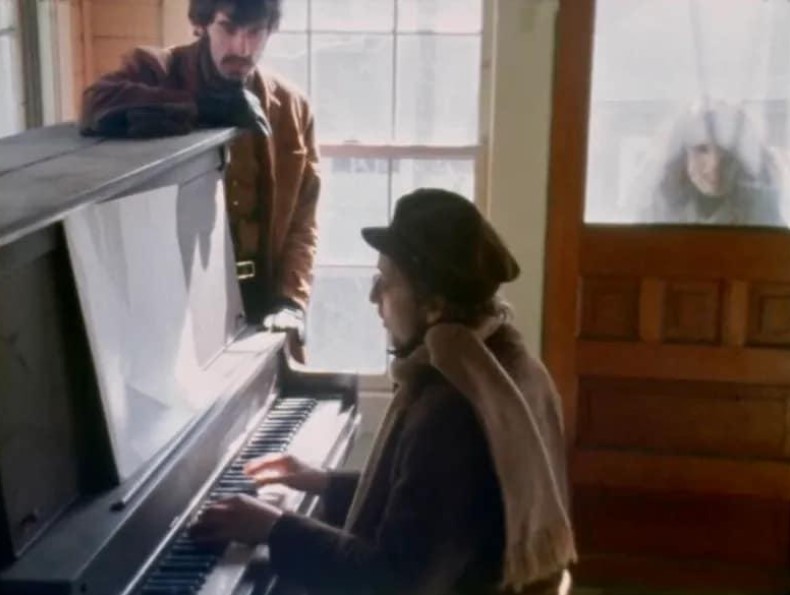
The Revols was a cover band out of Startford, Ontario. They were The Rebels but changed the name to The Revols, deferring to Duane Eddy and The Rebels. The band opened for Ronnie Hawkins and The Hawks in 1960, at which time The Hawk said to Levon Helm, “See that kid playing piano? He’s got more talent than Van Cliburn.” By the Spring of that year, Ronnie Hawkins was opening for The Revols. Ronnie offered to manage The Revols and booked them to play a club in Fayetteville, Arkansas. Upon their return to Ontario, he pinched the piano player and added him to The Hawks, with Levon, Robbie Robertson and Rick Danko. Garth Hudson would join by the end of the year. The piano player was Richard George Manuel, born 81 years ago today.
Despite having three singers in the group, the others all thought of Richard as the lead vocalist. His early songwriting contributions were singular compositions, with unexpected chord structures and melody lines. Songs like “Lonesome Suzie” and “In A Station” from Music From Big Pink are prime examples, though he also contributed the more straightforward “We Can Talk.” He also co-wrote the legendary “Tears Of Rage” with Bob Dylan, first recorded on The Basement Tapes. The follow-up, The Band, included three Manuel songs, “When You Awake,” “Jawbone,” and his greatest song, “Whispering Pines,” co-written with Robbie.
Richard had the chords, melody and vocal line for “Whispering Pines,” to which Robbie added the lyrics. He said, “Richard always had this very plaintive attitude in his voice, and sometimes just in his sensitivity as a person. I tried to follow that, to go with it and find it musically. We both felt very good about this song.” Manuel had written the music on a piano at Big Pink that had an out of tune key. When the group assembled in Los Angeles to record the official version, Richard was unable to sing it with a properly tuned piano, so it was de-tuned to accompany the vocal. The recording may be the greatest piece put down by The Band. Levon joins on the last verse in a call and response with Richard, Levon’s voice heavily echoed and set back in the mix. It is a staggeringly beautiful passage. Robbie put it best about Richard’s lead vocal: “The hurt in his voice…there’s a certain element of pain in there, that you didn’t know if he was trying to reach the note or he was just a guy with a heart that had been hurt.” Hear it for yourself:
By the time The Band recorded Cahoots, Manuel’s songwriting contributions had all but ended. Some speculated he was intimidated by Robbie’s growing leadership of the group and his expanded songwriting. Certainly Richard’s addictions added to the problems. Robbie more or less assumed the leadership when the others seemed incapable or disinterested, and didn’t offer songs of their own to the group. Robbie gets a bad rap in all this, though it was mainly Levon’s issue in the post 1986 years. The others didn’t express those gripes, and Robbie often included them in his own film related projects. Richard and Garth appear on The King of Comedy soundtrack. Rick appears on Robbie’s first solo album, along with Garth. And for the publishing and writing credits gripes, there are co-writing credits on several of the group’s albums. Robbie took on the larger roles largely out of necessity. That he kept an eye on his own finances is nothing for Levon, or anyone really, to have faulted him over. What The Band earned individually from the 1974 tour with Dylan gave them all nest eggs to invest.
But back to Richard. Despite his problems and loss of writing ability, he would remain the lead singer as far as the others were concerned. He could still deliver, into the early 80’s, when The Band reformed, wearing Ray Charles proudly on his sleeve:
Today’s Playlist is a SomethingIsHappening compendium of The Band songs featuring the great Richard Manuel:
 SomethingIsHappening
Leave a comment